Description
roduct Usage
This PRODUCT IS INTENDED AS A RESEARCH CHEMICAL ONLY. This designation allows the use of research chemicals strictly for in vitro testing and laboratory experimentation only. All product information available on this website is for educational purposes only. Bodily introduction of any kind into humans or animals is strictly forbidden by law. This product should only be handled by licensed, qualified professionals. This product is not a drug, food, or cosmetic and may not be misbranded, misused or mislabled as a drug, food or cosmetic.
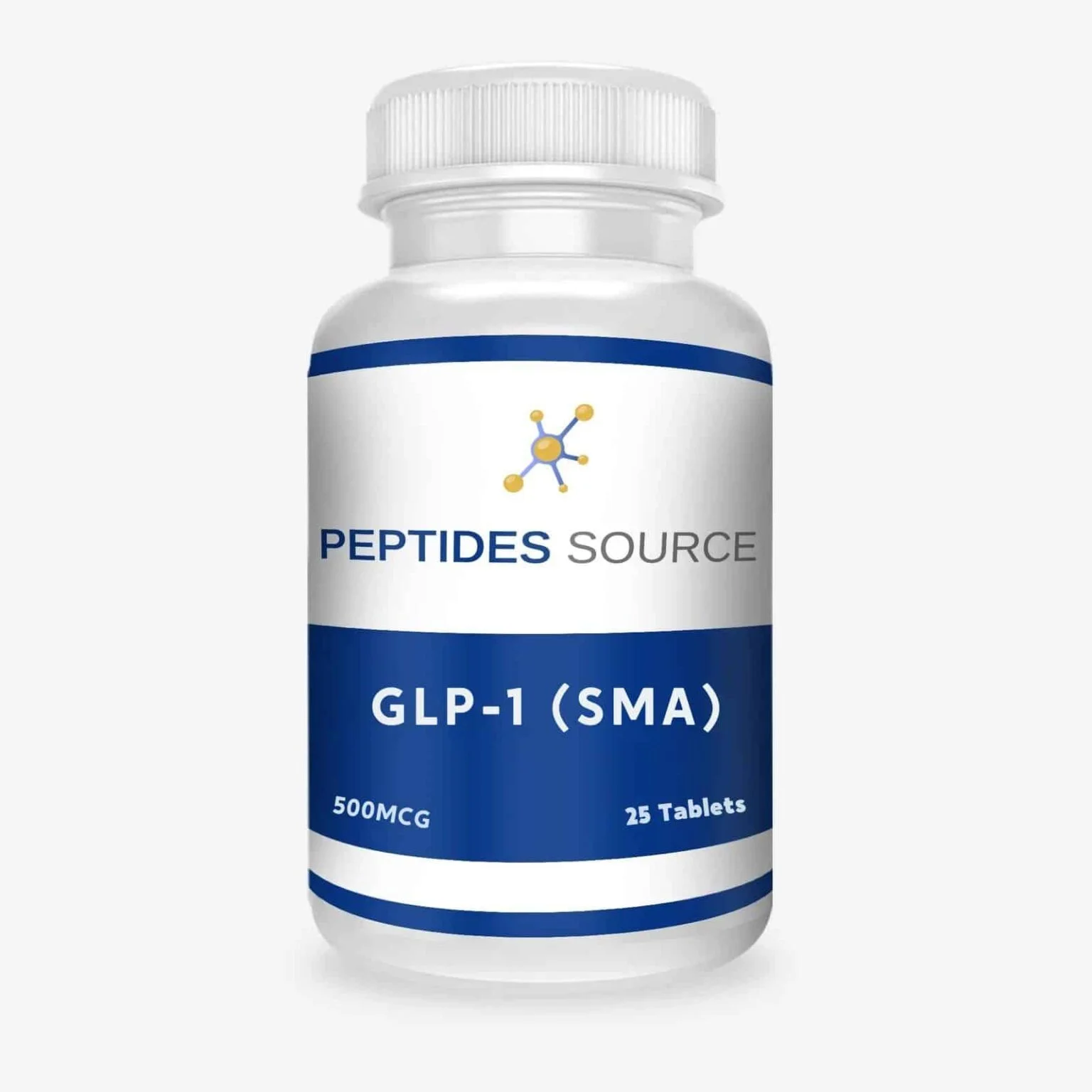
As a glucagon-like peptide-1 receptor agonist (GLP-1 RA), it increases the secretion of the hormone insulin which helps the cells to effectively utilize energy. This process ensures proper fat storage and decreases blood glucose (blood sugar) levels. GLP-1 (Sema) also suppresses your appetite and slows gastric emptying by blocking certain chemicals in the brain. This in turn helps promote fat loss. GLP-1 (Sema) 500mcg (25 Tablets). As a glucagon-like peptide-1 (GLP-1) receptor agonist, GLP-1 (Sema) works by mimicking the effects of the GLP-1 hormone, which regulates appetite and food intake. [1] The once-weekly injectable formulation of GLP-1 (Sema) has shown remarkable results in clinical trials, demonstrating greater weight loss compared to placebo and other weight-loss medications. By enhancing feelings of fullness, reducing hunger, and slowing down gastric emptying, GLP-1 (Sema) helps individuals achieve meaningful and durable weight reduction, making it a promising and valuable option for managing chronic weight issues and improving overall health outcomes.
Protocol
Compounded GLP-1 (Sema) is a form of GLP-1 (Sema) that is made by a compounding pharmacy. Compounding pharmacies are licensed to create customized medications for individual patients. In the case of compounded GLP-1 (Sema), the pharmacy may combine GLP-1 (Sema) with other ingredients, such as vitamins or minerals, to create a medication that is tailored to the specific needs of the patient. Compounded GLP-1 (Sema) is often used as a weight loss medication. GLP-1 (Sema) is a GLP-1 receptor agonist, which means that it works by binding to the GLP-1 receptor in the gut to help control blood sugar levels. However, GLP-1 (Sema) has also been shown to be effective at promoting weight loss. There are a few reasons why people might choose to use compounded GLP-1 (Sema) for weight loss. First, compounded GLP-1 (Sema) is often less expensive than brand-name GLP-1 (Sema). Second, compounded GLP-1 (Sema) can be tailored to the specific needs of the patient. For example, if a patient has trouble swallowing pills, the compounding pharmacy can create a compounded GLP-1 (Sema) that is administered as a liquid or a nasal spray. However, there are also some risks associated with using compounded GLP-1 (Sema). First, compounded GLP-1 (Sema) has not been as extensively studied as brand-name GLP-1 (Sema). This means that there is less information available about the safety and efficacy of compounded GLP-1 (Sema). Second, there is a risk that compounded GLP-1 (Sema) may not be made correctly. This could lead to the wrong dosage being given, or it could lead to the medication being contaminated. If you are considering using compounded GLP-1 (Sema), talk to your doctor about the risks and benefits. Your doctor can help you decide if compounded GLP-1 (Sema) is right for you.
Clinical Research
Drucker D. J. (2018). Mechanisms of Action and Therapeutic Application of Glucagon-like Peptide-1. Cell metabolism, 27(4), 740–756. https://doi.org/10.1016/j.cmet.2018.03.001 Wilding, J., Batterham, R. L., Calanna, S., Davies, M., Van Gaal, L. F., Lingvay, I., McGowan, B. M., Rosenstock, J., Tran, M., Wadden, T. A., Wharton, S., Yokote, K., Zeuthen, N., Kushner, R. F., & STEP 1 Study Group (2021). Once-Weekly Semaglutide in Adults with Overweight or Obesity. The New England journal of medicine, 384(11), 989. https://doi.org/10.1056/NEJMoa2032183 Kushner, R. F., Calanna, S., Davies, M., Dicker, D., Garvey, W. T., Goldman, B., Lingvay, I., Thomsen, M., Wadden, T. A., Wharton, S., Wilding, J., &Rubino, D. (2020). Semaglutide 2.4 mg for the Treatment of Obesity: Key Elements of the STEP Trials 1 to 5. Obesity (Silver Spring, Md.), 28(6), 1050–1061. https://doi.org/10.1002/oby.22794 Christou, G. A., Katsiki, N., Blundell, J., Fruhbeck, G., &Kiortsis, D. N. (2019). Semaglutide as a promising antiobesity drug. Obesity reviews : an official journal of the International Association for the Study of Obesity, 20(6), 805–815. https://doi.org/10.1111/obr.12839 Rubino, D., Abrahamsson, N., Davies, M., Hesse, D., Greenway, F. L., Jensen, C., Lingvay, I., Mosenzon, O., Rosenstock, J., Rubio, M. A., Rudofsky, G., Tadayon, S., Wadden, T. A., Dicker, D., & STEP 4 Investigators (2021). Effect of Continued Weekly Subcutaneous Semaglutidevs Placebo on Weight Loss Maintenance in Adults With Overweight or Obesity: The STEP 4 Randomized Clinical Trial. JAMA, 325(14), 1414–1425. https://doi.org/10.1001/jama.2021.3224

Reviews
There are no reviews yet.